
You can download the Conference Program as a PDF booklet here (File size: 6.3 MB).
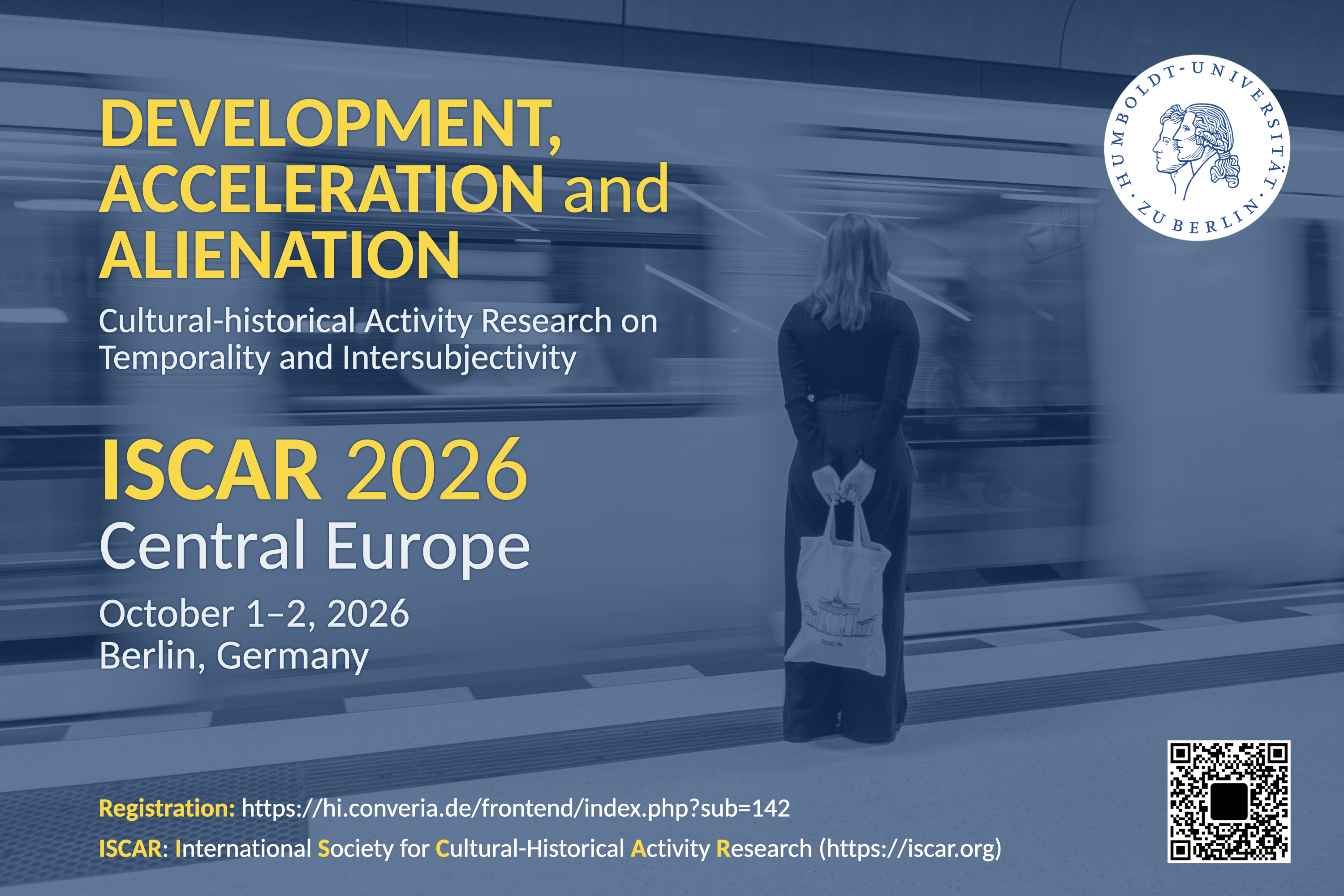
Development, acceleration and alienation.
Cultural-historical Activity Research on Temporality and Intersubjectivity
October 1-2, 2026
Development is movement and therefore takes time. It unfolds both individually and socially, at different speeds and against different temporal horizons. Lev S. Vygotsky's theory of development and his concept of the zone of proximal development emphasize the importance of intersubjectivity, learning and education as a “motor” for human development. Cultural and social developments – from the early forms of shared affects, through the emergence of spoken language and written symbols, to networked communication with digital media and AI – contribute to the acceleration of the activity systems in which we think, feel and act.
At the same time, as sociologist Hartmut Rosa has pointed out, modern subjects increasingly experience the growing acceleration of social life driven by new technologies, the economy, and social change as forms of alienation and isolation. If, however, human development is to succeed as a prerequisite for a good life, it requires experiences of intersubjectivity as meaningful spaces of resonance. In view of a highly automated social world in which countless interactions take place simultaneously, communication and decisions are optimized by algorithms, and everyone and everything appears constantly accessible and available, several questions arise: How much acceleration can development tolerate? What is the current relationship between individual and social development processes? How can the counterforces of deceleration and resonance be strengthened?
Against this background, the conference will examine the relationship between temporality and intersubjectivity.
|
Registration |
10 March 2026 - 31 July 2026 |
|
Paper Submission |
10 March 2026 - 15 April 2026 |
|
Feedback and Revision |
15 May 2026 - 1 June 2026 |
|
Acceptance or Rejection |
15 June 2026 |
|
Conference Homepage |
|
|
Conference Chair |
Thomas Hoffmann (HU Berlin) |
|
Organization Team ISCAR Central Europe |
Stefanie Müller (HU Berlin), Marco Mazereeuw (NHL Stenden, University of Groningen), Vera Schuurmans (Firda), Loes Meijer (UMC Utrecht), Jan Steffens (Universität Bremen), Monique Verhoeven (Utrecht University). |
|
Conference Office |
Kathy Wittenberg, E-Mail: ISCAR2026@hu-berlin.de |
ISCAR – International Society for Cultural-historical Activity Research is a global organization that brings together scholars and practitioners across disciplines and walks of life, engaged in just transitions to sustain life on the planet. It fosters the century-old tradition of cultural-historical and activity-theoretical research in diverse settings, work and communities (https://iscar.org).